
Project Managers:
Stefan Pogatscher
The European Research Council is funding open-topic pioneering research with EUR 2 million, aimed at dissolving the boundaries between basic and applied research as well as between individual scientific disciplines. The sole ERC funding criterion is scientific excellence, both of the project and of the researcher. Under the leadership of Univ.-Prof. Dr.mont. Stefan Pogatscher, the ERC Consolidator Grant project “HETEROCIRCAL – Intermetallic Phase Heterostructured Circular Aluminium Alloys” (April 2024 to March 2029) focuses on the recycling of aluminium scrap, which is becoming increasingly important in Europe. Secondary aluminium requires 90 to 95% less energy than primary aluminium, therefore causes fewer greenhouse gas emissions, and does not generate the production residue red mud. Unfortunately, metallurgy is governed by the principle that the purer metals and alloys are, the better their properties. This problem is further exacerbated by the fact that, once impurities have entered aluminium, it is technically barely feasible and economically unviable to remove them again. To date, up to 40 different aluminium alloys as well as copper and steels have been used in passenger cars. For the recycling of end-of-life vehicles, this complex material mix means that the high-purity alloys used can only be downcycled into low-purity cast engine blocks. In view of passenger car production of almost 100 million vehicles in 2017, the great potential of new recycling approaches becomes evident. HETEROCIRCAL addresses the question of what happens when the number of engine blocks declines due to the increasing spread of electric vehicles, and aims to break the paradigm of harmful impurities in aluminium alloys and turn their effects into something beneficial. The objective is to develop practicable measures for establishing advantageous structures of intermetallic phases in heavily contaminated aluminium materials. This includes manipulating impurity-induced intermetallic phases during solidification, heat treatment, and forming. In addition, the influence of impurities will be investigated in detail down to the nanometre scale by directly tracking the formation of intermetallic phases from the melt using in-situ transmission electron microscopy.
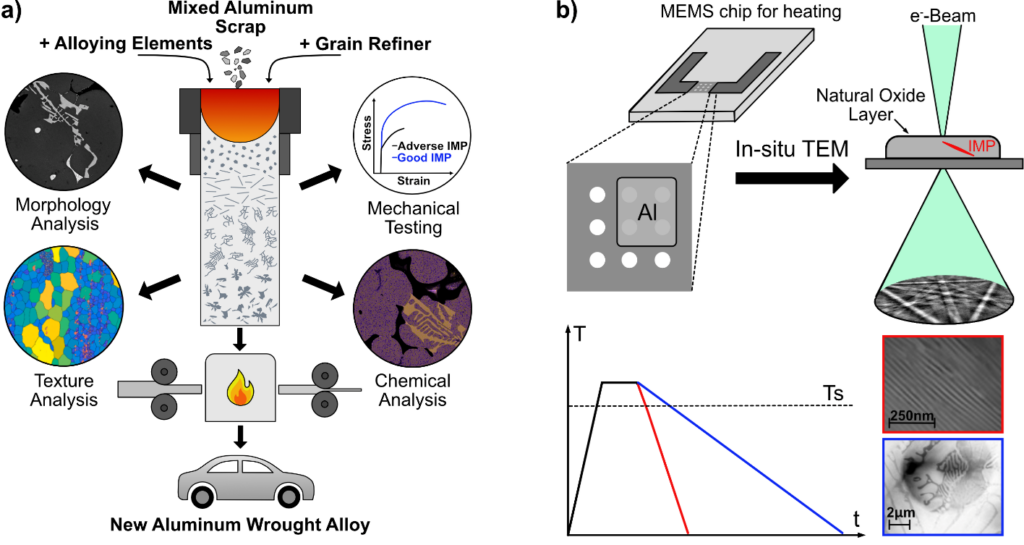
Fig.: Overview of (a) approaches for investigating highly contaminated recycled alloys containing different structures of intermetallic phases that can accommodate contaminants, and (b) fundamental studies of their formation using electron microscopy.